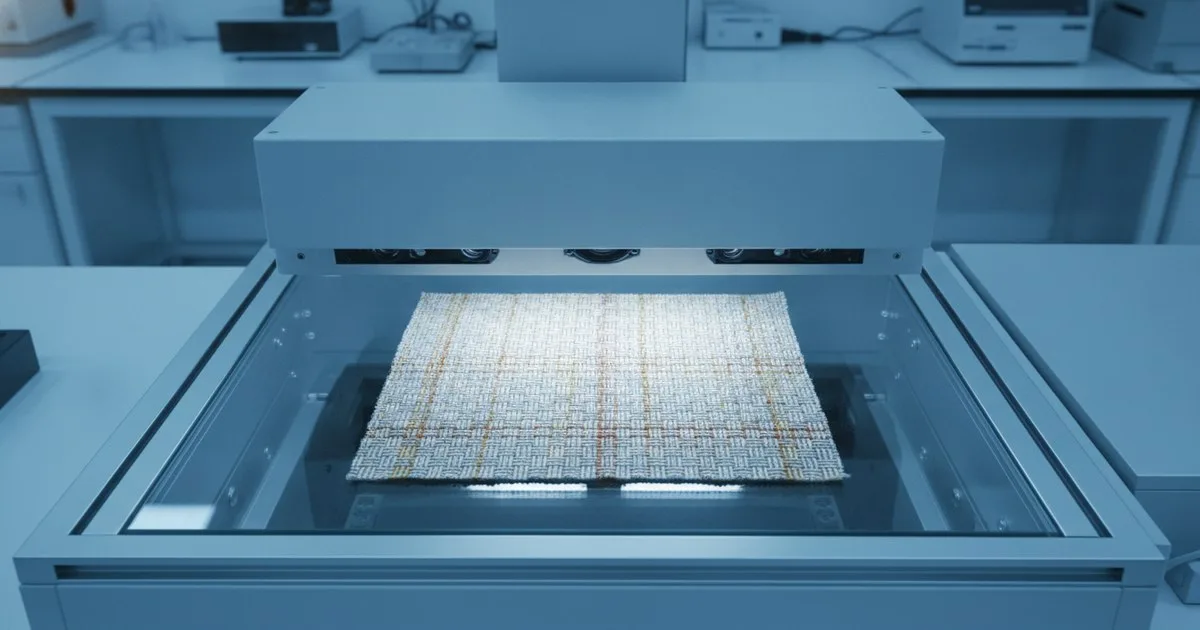
Physical fabric digitisation workflows already produce a structured, machine-readable record of material properties—yet the data they generate was designed for 3D design pipelines, not for regulatory disclosure. As the European Union's Digital Product Passport framework moves toward implementation for textile products, material developers and sustainability data leads need to understand precisely which parameters current scanning systems capture, which the regulation will additionally mandate, and how to bridge that gap without duplicating laboratory work.
Key takeaways
- Fabric digitisation systems such as Vizoo's xTex capture high-resolution optical and physical properties primarily to support 3D simulation fidelity, not regulatory disclosure.
- A Digital Product Passport for textiles will require supply-chain provenance, chemical composition, recyclability indicators, and social compliance data that no scanner can derive from the fabric surface alone.
- The overlap between what digitisation already measures and what a DPP needs is real but partial: colour, surface texture, and certain mechanical properties are genuinely shared; origin, fibre blend, and end-of-life instructions are not.
- Platforms that aggregate digitised material libraries—such as Frontier.cool's TextileCloud—are positioned to serve as a data layer connecting physical measurements to DPP-structured records, but the regulatory schema is not yet finalised.
- Material developers who start mapping their existing digitisation outputs against draft DPP data fields now will reduce rework when implementing requirements come into force.
What is a Digital Product Passport for textiles, and why does it matter?
A Digital Product Passport (DPP) is a structured, machine-readable data carrier—typically linked to a physical product via a QR code, RFID tag, or data matrix—that records a product's composition, origin, environmental footprint, repair and recycling instructions, and supply-chain actors across its full lifecycle. The European Commission's Ecodesign for Sustainable Products Regulation (ESPR) establishes the legal basis for DPPs across product categories, with textiles among the priority sectors targeted in early implementing acts.
For a textile product, the DPP is expected to hold, at minimum: fibre composition by weight, country of origin for each manufacturing stage, chemical substances of concern, durability and repairability information, carbon and water footprint indicators, and end-of-life handling instructions. The BSR analysis of digital passports for clothing notes that a common data language—such as the CircularID Protocol—will be needed for brands to communicate consistently across the product lifecycle.
The critical point for material developers is that the DPP is a disclosure instrument, not a simulation asset. Most of the data it requires must be collected at source—from mills, chemical suppliers, and logistics partners—rather than derived from the finished fabric by a scanner.
What does xTex actually measure?
Vizoo ships the xTex™ hardware and software system for high-resolution physically based rendering (PBR) material digitisation, alongside the physX™ platform for rapid physical fabric property acquisition. Together, these systems are used in 3D apparel design workflows with tools such as CLO, Browzwear, and Style3D.
An xTex scan produces several distinct data outputs:
Optical and surface parameters
- Colour maps (diffuse/albedo): Calibrated, high-resolution colour capture under controlled illumination, producing accurate RGB values across the fabric surface.
- Normal maps: Surface microstructure—weave topology, pile direction, yarn crimp—encoded as a per-pixel normal vector field.
- Roughness and specular maps: Reflectance properties that determine how the material interacts with virtual light sources.
- Displacement maps: Macro-surface geometry, capturing thickness variation and texture relief.
- Transmission maps (where applicable): For sheer or semi-transparent fabrics, the degree of light transmission through the weave.
These outputs are designed to enable photorealistic 3D rendering. They are objective, repeatable, and machine-readable—attributes that make them, in principle, compatible with a DPP data schema.
Physical and mechanical parameters (physX)
The physX platform extends digitisation into the mechanical domain:
- Bending stiffness: How the fabric resists deformation under its own weight—critical for drape simulation.
- Shear stiffness: Resistance to in-plane angular deformation.
- Stretch and elasticity: Elongation under load in warp, weft, and bias directions.
- Weight (grams per square metre): Areal density, which governs how a garment hangs and moves.
- Friction coefficients: Surface-to-surface and surface-to-skin friction, relevant for layering and wear simulation.
These mechanical parameters are measured rapidly—physX is designed for speed in a sampling workflow—and are output in formats compatible with major 3D simulation engines.
Which of these measurements overlap with DPP data requirements?
The overlap is genuine but narrower than it might appear. The table below maps xTex/physX outputs against the categories of data a textile DPP is expected to require.
| DPP data category | Covered by xTex/physX? | Notes |
|---|---|---|
| Colour and surface appearance | Yes | Diffuse, normal, roughness maps provide objective colour and texture records |
| Fabric weight (g/m²) | Yes | physX measures areal density directly |
| Mechanical properties (drape, stretch) | Partially | Bending, shear, and stretch data are captured; standardised test equivalences (ISO 9073, ASTM D1388) need to be established |
| Fibre composition by weight | No | A scanner reads surface optics; it cannot determine fibre blend percentages |
| Chemical substances of concern | No | Requires laboratory analysis or mill-supplied REACH declarations |
| Country of origin (fibre, yarn, fabric, garment) | No | Supply-chain provenance is a documentary, not a physical, attribute |
| Carbon and water footprint | No | Lifecycle assessment data must be modelled from supply-chain inputs |
| End-of-life instructions | No | Regulatory or brand-defined content, not a measured property |
| Recyclability indicators | No | Depends on fibre blend, dye chemistry, and construction—not surface optics |
| Durability / repairability | No | Requires standardised wear and abrasion testing |
The honest conclusion: digitisation workflows contribute two categories of DPP-relevant data—appearance and certain mechanical properties—out of a much larger set. They are necessary but far from sufficient.
Where does the data gap sit, and who fills it?
The parameters a scanner cannot derive—fibre composition, chemical safety, provenance, lifecycle impact—must come from the supply chain itself. This is the fundamental architectural challenge for DPP implementation in textiles: the data exists, but it is distributed across mills, spinners, dye houses, and chemical suppliers, often held in formats that are not interoperable.
Research on digital product passports for cleaner production examines how DPPs can drive adoption of sustainability-oriented technologies in the fashion sector, noting that economic incentives and data infrastructure are both required for uptake.
For material developers, the practical implication is that a fabric's DPP record will need to be assembled from at least three distinct data sources:
- Mill documentation: Fibre composition certificates, OEKO-TEX or GOTS compliance records, country-of-origin declarations.
- Laboratory testing: Chemical safety (REACH), colorfastness, durability, and—where claimed—recyclability assessments.
- Digitisation outputs: Colour, surface, and mechanical data from systems such as xTex and physX.
The third source is the one most material developers already have, or can acquire most readily. The first two require supply-chain relationships and, in many cases, third-party certification.
How do digital material platforms fit into this architecture?
Platforms that manage digitised fabric libraries at scale are a natural aggregation point for DPP data assembly. Frontier.cool ships TextileCloud™, an AI-powered enterprise materials management platform that digitises physical fabrics into 3D texture maps and physics data, and provides cloud-based 2D/3D material libraries, AI-powered search, palette creation, vendor and brand portal collaboration, and PLM integration. Its architecture—which links physical fabric samples to structured digital records and connects brands with suppliers—maps closely onto the kind of multi-party data assembly a DPP requires.
The question is whether such platforms will extend their data schemas to accommodate the full DPP field set, including the non-scannable attributes. That extension is not a digitisation problem; it is a data modelling and supply-chain integration problem. Platforms that solve it will become infrastructure for DPP compliance, not merely tools for 3D design.
Seddi approaches the material layer from a different direction: its Textura.ai platform generates 3D digital textiles, and its Decorator™ workspace creates true-to-pattern digital replicas of real blank garments for artwork placement and production instructions. While Seddi's current focus is on visual fidelity and branded apparel workflows, the underlying material data it handles—fabric appearance, construction, physical behaviour—is the same data that DPP schemas will need to reference.
What should material developers do now, before the schema is finalised?
The implementing acts that will specify the exact DPP data fields for textiles are not yet in force. This creates a window—not for inaction, but for preparation. Specifically:
-
Audit your existing digitisation outputs. Catalogue which xTex and physX parameters you already capture for each fabric in your library. Identify which are stored in structured, exportable formats versus embedded in proprietary project files.
-
Map those outputs to the draft ESPR data categories. The European Commission has published indicative data requirements for textile DPPs in its preparatory studies. Cross-reference your existing fields against those categories to identify the overlap and the gaps.
-
Identify which gap data you already hold elsewhere. Fibre composition is often in your PLM or ERP system. Mill certificates may be in supplier portals. REACH declarations may be in procurement records. The data may exist; it may simply not be linked to the fabric record.
-
Establish a linking mechanism. Decide whether your material management platform, PLM, or a dedicated DPP middleware will serve as the record of assembly. Platforms like TextileCloud are candidates; so are PLM systems with material modules.
-
Engage your mill and supplier network. The data that scanners cannot produce must come from upstream. Start requesting structured data—not just PDF certificates—from your key fabric suppliers now, while the regulatory deadline is not yet imminent.
-
Track the standard-setting process. Industry bodies including the European Apparel and Footwear Alliance and GS1 are active in defining DPP data standards. Following their outputs will give you earlier visibility into the final schema than waiting for the implementing act.
What remains unsolved
Several technical and governance questions have no settled answer yet:
- Measurement standardisation: xTex and physX outputs are not currently mapped to ISO or ASTM test standards in a way that regulators can reference. Whether self-measured mechanical data will satisfy DPP disclosure requirements, or whether accredited laboratory testing will be required, is unresolved.
- Data sovereignty: A DPP must be accessible across the supply chain and to consumers, but it also contains commercially sensitive supplier information. The governance model for who controls which fields, and under what conditions, is still being negotiated at EU level.
- Update cadence: A fabric that is reformulated mid-season—different dye lot, different fibre blend—requires a DPP update. The workflow for maintaining DPP accuracy across a live product range is not yet defined.
- Interoperability: The CircularID Protocol, GS1 standards, and various national DPP pilots are not yet fully interoperable. A brand digitising fabrics today cannot be certain which data format its DPP will ultimately need to conform to.
These are not reasons to delay preparation; they are reasons to build flexible data infrastructure rather than hard-coding to any single schema.
FAQ
What is a Digital Product Passport and when will it apply to textiles? A Digital Product Passport is a machine-readable data record attached to a physical product, disclosing its composition, origin, environmental impact, and end-of-life instructions. The EU's Ecodesign for Sustainable Products Regulation establishes the legal basis; textiles are among the priority categories, though the specific implementing act and its effective date have not yet been finalised.
Can a fabric scanner replace laboratory testing for DPP compliance? No. Scanners capture optical and mechanical surface properties. DPP requirements also cover fibre composition, chemical safety, supply-chain provenance, and lifecycle impact—none of which can be derived from a scan. Laboratory testing and mill documentation remain necessary.
Which xTex parameters are most directly useful for a textile DPP? Colour maps (calibrated RGB), fabric weight in grams per square metre, and mechanical properties such as bending stiffness and stretch are the most directly transferable. Surface texture data is useful for product identification and traceability but is not a primary DPP disclosure field.
Do I need to re-digitise my fabric library to prepare for DPP requirements? Not necessarily. If your existing digitisation outputs are stored in structured, exportable formats, the task is to link them to the additional data fields a DPP requires—not to re-scan. Audit your current data architecture before commissioning new scanning work.
What role do material management platforms play in DPP compliance? Platforms that aggregate digitised fabric records and connect brands with supplier data—such as TextileCloud—are natural candidates for DPP data assembly. Whether they will extend their schemas to cover the full DPP field set, including non-scannable attributes, depends on how those platforms evolve and how the regulatory schema is finalised.
Is the DPP data schema for textiles already fixed? No. The European Commission has published indicative data requirements in preparatory studies, but the implementing act that will specify mandatory fields, formats, and timelines for textiles is not yet in force. Monitoring the standard-setting process through industry bodies and GS1 is the most reliable way to track developments.
Further reading
- Digital Passports for Clothing — BSR
- Digital product passports for cleaner production: Economic evidence — ScienceDirect